Corona Ruptures Scaffolding

With corona virus spreading and lock down being put into place my running has suffered. As social distancing has been put in place I have been unable to access my peer support in the same methods as I used to.  This lack of social support has had a negative effect on my running as it means I’ve been getting out and on the track less often.

Throughout this module the lecturers and classes have provided me with a good level of scaffolding to kick-start my running and help support me as I learned the proper training plan, how to stay motivated and just about everything else . Scaffolding is a process described by Wood, Bruner and Ross  in which more educated peers aid an individual with a task, which they wouldn’t be able to complete unaided. Scaffolding is normally carried out by more educated peers leading an activity to guide an individual on what to do.

Pol, Volman & Oort evaluated the effects scaffolding within a classroom setting and found that students improved in test scores. However it has been suggested that maintaining personal sub goals for each student to build one skill isn’t time efficient. Additionally Freund found scaffolding to be more effective than discovery learning ( a process where individuals work in isolation and discover new skills by trial and error), when children were given an organisation task . Jones and Thomas discussed how scaffolding can be used in athletes training to help push them to new levels, developing their skill further.

Within my marathon training scaffolding has taken place within the format of formal taught classes and seminars, in which we have been presented with information on running techniques and the psychological background into areas such as goal setting. Additionally, this class run occurred weekly which provided me with practical support as well as academic support.

 The process of scaffolding can be further broken down into four main stages as suggested by  Puntambekar & Hubscher. Initially the peer or teacher will assess what knowledge the individual already has, they will then relate pre-established knowledge to a new skill. Once they have identified what they want the new skill to be they will break it down into smaller goals which they will work on individually. The individuals will then use their new skill with minimal verbal prompting. Once the new skill is built up you repeat the model with the next skill.

Scaffolding has a large overlap with  Vygotsky’s Zone of Proximal Development (ZPD). A diagram of Vygotsky’s model of development is shown below. The model requires the presence of a more knowledgeable other to help aid individuals when they are unable to complete a task. The main difference between ZPD and Scaffolding is that scaffolding focuses on breaking down the goal to help the individuals achieve new skills, whereas ZPD solely focuses on the knowledge of the more knowledgeable person to fill in any gaps in knowledge.

It has been suggested that breaking the new skills down into smaller skills, or a smaller topic of knowledge, can help individuals become more independent within their learning. This independence is said by Radford, Bosanquetb, Webster and Blatchford to be built up as individuals start to think more critically and break down their own tasks independently without assistance. Learning these skills means that difficult new skills in the future will be easier for individuals to comprehend.

As the individual learns more skills and develops a better knowledge the scaffolding is removed, leaving them to develop the new skills alone. This removal of scaffolding should be done gradually to allow for the individual to adjust and slowly start to feel comfortable working on their own. The graph below shows how overtime as individuals comprehend more things guidance can be decreased until it is no longer there. If scaffolding is removed too quickly it can limit the  ability of the individuals to learn new skills , as they might not have had time to fully develop knowledge and new skills.

Within my Born to Run module the scaffolding of classes and group run was cut short due to corona virus. This sudden removal of my scaffolding was definitely too soon for me, without the verbal prompts of my peers and lecturers my running seemed to slowly drop to the point I feel like I run once every blue moon. Although online resources are available I don’t find them as useful as running with people, I find the verbal prompting to be very effective to keep me motivated.

Although models of scaffolding have found to be effective in classrooms, Ramstead, Veissière & Kirmayer found it to be culturally biased implying it might not be as effective within non-western countries and could even hinder children’s ability to reach their ZPD. It has also been discussed  by Jumaat and Tasir that there is a limited amount of standardised research to adequately support the theories. Both ZPD and scaffolding are not quantifiable so it is difficult to actually measure whether these model help a child learning and if hey do by how much 

Conclusion 

Keeping this in mind i have come up with a devilish plan… I plan to skype my favourite running partner and go on runs while skyping. Although i doubt that this will help me develop new skills, his verbal prompting will help me practice the skills I already have which prevent me from going back to square one.

Refernces 

Wood, D., Bruner, J. S., & Ross, G. (1976). The role of tutoring in problem solving. Journal of child psychology and psychiatry, 17(2), 89-100.

van de Pol, J., Volman, M., Oort, F., & Beishuizen, J. (2015). The effects of scaffolding in the classroom: support contingency and student independent working time in relation to student achievement, task effort and appreciation of support. Instructional Science, 43(5), 615-641.

Robyn L. Jones & Gethin Ll. Thomas (2015) Coaching as ‘scaffolded’ practice: further insights into sport pedagogy, Sports Coaching Review, 4:2, 65-79, DOI: 10.1080/21640629.2016.1157321

Sadhana Puntambekar & Roland Hubscher (2005) Tools for Scaffolding Students in a Complex Learning Environment: What Have We Gained and What Have We Missed?, Educational Psychologist, 40:1, 1-12, DOI: 10.1207/s15326985ep4001_1

McLeod, S. A. (2019). What Is the zone of proximal development? . Simply psychology: Psychology. https://www.simplypsychology.org/Zone-of-Proximal-Development.html

Radford, J., Bosanquet, P., Webster, R., & Blatchford, P. (2015). Scaffolding learning for independence: Clarifying teacher and teaching assistant roles for children with special educational needs. Learning and Instruction, 36, 1-10.

Ramstead, M. J., Veissière, S. P., & Kirmayer, L. J. (2016). Cultural affordances: scaffolding local worlds through shared intentionality and regimes of attention. Frontiers in Psychology, 7, 1090.

N. F. Jumaat and Z. Tasir, “Instructional Scaffolding in Online Learning Environment: A Meta-analysis,” 2014 International Conference on Teaching and Learning in Computing and Engineering, Kuching, 2014, pp. 74-77.

Nudging Myself into Action

Posted byellie prior-clarkePosted inUncategorized

Personalities. Huh. Does anyone else forget that not everyone has the same personality, or that personalities even exist. Okay, so that’s probably just me. It has recently been brought to light in a lecture that personality types affect my running. It seemed obvious that different people would face different challenges but never had I considered it would be caused by innate personality traits, instead of external factors. It was suggested by Egloff & Gruhn that even simply being an introvert will inhibit your chance of becoming a runner.  

After being reminded about personality types I decided it would be interesting to find out exactly what mine was. According to the Disc Test  I’m dominant! Which isn’t wrong but not exactly what I wanted to hear. Especially as it essentially means that I’m bossy.

 The disc test is a personality test comprised of four main factors as shown in the diagram above, that are based on Marstons personality traits. Profiling individuals using the disc model allows for more effective motivational strategies, knowledge on the areas in which individuals can develop and can help figure out what individuals ideal sporting environment would be. The table below demonstrates what inferences can be made from having a dominant personality:

Priority: To focus on the set goal 
Strengths: Setting and striving for high standards 
Fears:Not having control
Growth areas: ImpatientPoor listening skills
Under stress Critical 
Ideal sporting environment:Efficient Structured

Although personality testing is useful for finding strategies to help plan how to best adapt to common personality traits within teams or workplace settings, it is a reductionist viewpoint and doesn’t account for individual variation. It also fails to account for individuals having similar levels of two different personality types.

Based on the previous information shown in the table it can be inferred that I would perform my best environment in an environment which i control. It would also be beneficial for me to train in an environment where I control the structure in order to feel I am working towards my goal. However due to my general lack of physical health my runs have not been the standard i hoped they would be at, this has caused me to feel demotivated and miss some training runs. This is  shown in the table below where red means not completed and green means completed in the previous two weeks. 

Monday Tuesday Wednesday Thursday Friday SaturdaySunday 
3M tempo Class runRest 4m Farlex/HillsRestRest 6M
4m tempo Class run Rest 5m Farlex/Hills Rest Rest 8M 

To stop me from skipping runs in the future i am going to use nudges to help prompt me into running. Nudges are a behavioural technique that use prompts to increase a behavioural response by presenting someone with a stimuli associated to the behaviour. An example of a nudge would be leaving my running clothes on my chair ready to be used. John (2016) said that multiple different nudges are better than just one to maximise the exposure, so i am going to set up a few different nudges around my house.  Firstly as a nudge Ii will leave my trainers in front of my door, I will also pin my running schedule on my wall and last i will make sure to always set my kit out on my chair where i can see it. Hopefully these three nudges will encourage me to go on more runs

Nudges can be used to help build habits, nudges act as a reminder for habit behaviours. An example of a habit would be going on a run everyday after waking up. The process in which habits are formed is shown in the diagram below.

To apply this model to my day-to-day life  I will be pinning my run schedule to the wall. Seeing the schedule will remind me to go for a run, which causes the sense of pride I get after a run. This sense of pride will cause me to go on more runs the due to the reward; building into a habit. In order to ensure my running pattern becomes a habit, I will be giving myself greater rewards for areas that I am lacking, for example class runs which I have missed quite a few of. If I go on a class run I will buy myself a new plant (which may just be some of my favourite things in the world).

If I manage to induce a habit of running, the next step is maintaining them.  Becker-Philips  suggests that to help maintain goals, you should take small and achievable steps towards it rather than trying to tackle it head-on. This is to minimise failure that may result in the behaviour slipping. An example of which is starting running smaller distances when you first start training, instead of trying to run a marathon everyday.Although progress may eventually be made if I attempted a marathon frequently with no goals in between, it would take a far greater energy investment than the alternative. This would also increase the probability that I gave up entirely. Although Becker-Phillipps discusses how to not give up, she doesn’t explore how to progress within and beyond initial goals, which I feel would be limiting and cause a lack of motivation.

King (2016)  suggested that an effective way to sustain habits is to log activities, so to record runs. Recording activity gives you a log to track yourself with so you can observe if behaviour starts to drop. It was also suggested  that you have to build habits that you enjoy or have suitable rewards or you might not be reinforced enough to maintain behavioural habits. 

Another method to maintaining motivation is by continuously setting bigger goals and challenging yourself. This prevents you from ever reaching the finish line for a goal, as there will always be a new one. For example, if you wanted to maintain the behaviour of running races but were not motivated by repeating the same distance (me), you would motivate yourself with the next goal, the next distance. 

Overview: 

Overall I think these two weeks have been positive as I have been upping my mileage and preparing for the half marathon (two weeks time). I think that understanding my personality type will aid me by helping me figure out where and when will be the best environment to train in.

I have found nudges to be useful, however if i am not in the mood  to run they are very easily ignored. Occasionally the nudges can also feel a bit like shoving and might not be the best method for me as I tend to get annoyed at them . They are also very much limited to reminding me to run not motivating me to go out and do it and after a few days they all became background noise to everything else i have in my house.

2 weeks till half marathon, 14 till the marathon itself at the moment i feel on track but let’s see if i can maintain this progress! 

References:

Egloff, B., & Gruhn, A. J. (1996). Personality and endurance sports. Personality and individual differences21(2), 223-229.

Eysenck, H. J., & Eysenck, S. B. (2013). Personality structure and measurement (psychology revivals). Routledge.

Hertwig, R., & Grüne-Yanoff, T. (2017). Nudging and Boosting: Steering or Empowering Good Decisions. Perspectives on Psychological Science12(6), 973–986. https://doi.org/10.1177/1745691617702496

Manson, G. E. (1926). A bibliography of the analysis and measurement of human personality up to 1926. Reprint & Circular Series of the National Research Council, 72.

Peters, B. G., & Zittoun, P. (2016). Contemporary approaches to public policy. Theories, controversies and perspectives. UK: Palgrave Macmillan.

Runspiration

Blog 1: The S(t/M)ART of the End

Posted byellie prior-clarkePosted inUncategorized

The Liverpool rock and roll marathon…. A yearly event where roughly 20, 000 people partake in a weekend of running events. Whether they are attempting the 1 mile, 5k, or half marathon they all cross the start line with a goal, whether it be to win or achieve their best time so far. My Goal? To cross the finish line at the end of the full  42.2K… preferably alive.

Throughout our lives we frequently set goals, whether we realise it or not. There are two types of goals; explicit and implicit . Explicit goals are consciously generated and are usually more directly beneficial to an individual’s motives. An example of an explicit goal would be to run 5 k. Implicit goals are unconscious and associated with immediate rewards, these goals are generally beneficial to the person. An example of an implicit goal would be to put my trainer on before a run. My goal to run a marathon is an explicit goal with the overall aim of increasing my fitness.

Leading up to starting the module ‘Born to Run’, I think I was in denial of just how much work I have to put in. This truly hit me as I went on my first run and was wheezing for breath after only 2 kilometres, (40 more needed to finish a marathon!). I realised I’d have to get my act together and start to plan my training.

Upon reflection I believe that before the classes had started I was enjoying the pre-decisional stage of Rubicon’s model of action; a model which outlines the steps taken towards achieving a goal, and how to achieve these. 

While I was in this stage prevented me from making physical progress towards my goals, as I was only contemplating a marathon and not planning for one. To move forward with my goals and reach the pre-actional stages of Rubicons model (shown in the diagram above), I have to start planning how to build up my physical fitness and learn how to endure the longer runs

While I was in this stage prevented me from making physical progress towards my goals , as I was only contemplating a marathon and not planning for one. To move forward with my goals and reach the preactional stages of Rubicons model (shown in the diagram above), I have to start planning how to build up my physical fitness and learn how to endure the longer runs

SMART goals setting can have a powerful effect on goal success, as the process of going through the individual steps and motives breaks the goal down into achievable steps. I found the process of going through my own goals (image bellow) made the marathon more realistic, causing me to focus more on what I need to do on a day to day basis to achieve my goal. 

While writing my SMART goals I tried to use another psychological strategy called implementation intentions. This strategy involves plans that help to avoid excuses. The strategy can involve changing wording such as instead of saying ‘I might go on a run tomorrow’ you change it to ‘tomorrow I will run at 5 o’clock’. I tried to implement this idea of determination in my phrasing by saying ‘I will achieve’ ‘ I will measure. By using  this I’m trying to change my mindset to build more resilience against excuses. Implementation intentions are often used by having ‘ ‘If , Then’ statements.  I will incorporate  this strategy into my running i’m going to use the phrase ‘ if its a day starting with T or S then i will run’. 

Alongside this method I will also be doing most of my runs with my partner Tom, who has a slightly quicker pace than me, this pushes me to go faster and ensures I go on the runs I plan. Running together has helped me stay motivated on long runs and to continue even though i would prefer to stop, as I find the encouragement of my friends to be useful. There’s a saying in running, ‘If you want to go fast, go alone, if you want to go far, go together’, at  the moment I just want to go, and having someone to hold me accountable should help me stay on track. 

Initial Review as a Marathoner (possibly?):

In summary, I have found the concept of setting myself a goal using SMART techniques to be useful, however I do not think it directly aids my running. In order to use these strategies to help my running, I will make a weekly running schedule using the same technique, breaking goals down into smaller, more achievable goals. I think these small wins will help me maintain motivation over a longer period of time.

I have found the running strategy of having a partner to be the most effective, as it is harder to persuade two people to just stay in and binge watch Netflix . Due to my lack of persuasive skills this method has kept me on track with my running, and I will continue to run with friends throughout the next weeks.

Overall, I have actually started to enjoy running, and with no injuries or muscle aches, it feels like success to me!

References

Amabile, T. M., & Kramer, S. J. (2011). The power of small wins. Harvard Business Review, 89(5), 70-80. doi:10.1111/peps.12022_2

Jayawickrama, J. (2018). ” If You Want To Go Fast, Go Alone. If You Want To Go Far, Go Together.”: Outsiders Learning From Insiders in a Humanitarian Context. Interdisciplinary Journal of Partnership Studies, 5(2), 5-5. doi.org/10.24926/ijps.v5i2.1309

Mayo, B. (1957). Conditional statements. The Philosophical Review, 291-303. doi;10.2307/2182436

Gollwitzer, P. M., & Sheeran, P. (2006). Implementation intentions and goal achievement: A meta‐analysis of effects and processes. Advances in experimental social psychology, 38, 69-119.doi.org/10.1016/s0065-2601(06)38002-1 

Chang, A., Chou, C. L., Teherani, A., & Hauer, K. E. (2011). Clinical skills‐related learning goals of senior medical students after performance feedback. Medical education45(9), 878-885. doi/epdf/10.1111/j.1365-2923.2011.04015.x

Bovend’Eerdt, T. J., Botell, R. E., & Wade, D. T. (2009). Writing SMART rehabilitation goals and achieving goal attainment scaling: a practical guide. Clinical Rehabilitation23(4), 352–361. doi.org/10.1177/0269215508101741

Gollwitzer, P. M. (1990). Action phases and mind-sets. Handbook of motivation and cognition: Foundations of social behavior, 2, 53-92. doi:10.4135/9781446249215.n26

Blog 4: Gritting There

Looking back on this last week, it has been mayhem, with what seems like a million upcoming deadlines, the weather changing from sunshine to hail in a minute and work being closed due to coronavirus I have struggled to find time for training. However I have still managed to complete my training (training plan shown in table below), I believe this demonstrates that I am a gritty person.

MondayTuesdayWednesdayThursdayFridaySaturdaySunday
3 miles 6 miles yogaPole fitnessRest 3 miles12 miles

Grit is the ability to persevere in something you feel passionate about when faced with challenges. Grit was initially described by Duckworth & Gross as the capacity for hard work, they further added that this specifically entitled maintaining enthusiasm overtime. According to Duckworth, Peterson, Matthews & Kelly, Grit involves strenuous work towards challenges, and maintaining effort and motivation even when failure and adversity are present. Having grit is both a personality trait and an individualistic skill. Grit in running has been described as the ability to simply continue in long distance, the ability to ignore your muscles saying stop and to continue on in a race.

Grit has been correlated with predicting high levels of success among individuals. Grit allowed people to successfully predict achievement in a variety of contexts ;Robertson-Kraft and Duckworth observed that grittier teachers outperformed other teachers when meeting the demands of teaching. Eskreis-Winkler, Shulnal. Beal and Duckworth found that grittier individuals perform better in a variety of situations. In their study observed that grittier men are more likely to stay married, grittier employees are more likely to keep their jobs, and that grittier soldiers are more likely to advance in the ranks. Gritty runners are more likely to run longer distances with a shortened training plan.

The essential features needed to have high levels of grit are  passion and perseverance. Passion refers to the reason for your goal, and can be developed through practice and determination. Practice helps build passion due to repetition of actions causing improvement, this success makes individuals more and more confident so more likely to enjoy the activity. Perseverance refers to continuing towards your goal even when adversity may present itself. This can further be demonstrated by the idea that usually difficulties damaged individuals views of their goals, whereas individuals who have a high level of grit tend to stay on track better.

Grit has been found to be highly interlinked with self control, which is seen as another predictor of success. Self-control can be defined as the ability to control one’s own behavior when faced with an alternative better option. An example of self control would be making myself go on a run instead of watching netflix in bed.  Self-control is believed to be linked to willpower and can be described as the  ability to regulate behaviours to  help reach a goal. Duckworth and Gross commented that even though both models entail aligning actions to intentions, they both operate in different ways over different time scales. 

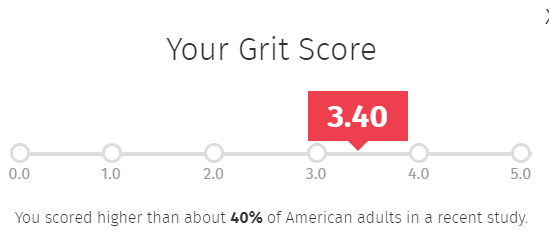
Of course I went routing around the internet to find an online test to find out where I was ranked on the grit scale. As shown in the image below I ranked 3.4 out of  5, which is reported to be 40% above the average American. So what does this actually mean? This means I have the ability to persevere through some challenges towards my goals but I will struggle to remain training if the adversity continues. For example if there is bad weather I will still go training but if it continuously hails outside I will skip a run.  

However seeing that I am not  100% gritty I did the logical thing and wondered how I could become more gritty. In a ted talk by Duckworth she discusses that the only known method is to develop a growth mindset. Growth mindsets are a part of the personal growth theory, developed by Dweck. It suggests that there are two mindsets; fixed and growth. Fixed mindsets are focused around the concept that talents are innate and that an individual has talent or they do not. Growth mindsets focus around the idea that success is due to effort and critical thinking (key features of growth mindsets are listed in the table below). In Dweck’s 2009 study sport coaches highlighted that the key feature to aid in sport is the fact that people with growth  mindsets are less fearful of failure.

Welcome challenges 
Persevere through setbacks
Learn from past mistakes

According to Travis some key ways to build a self-growth mindset are to actively put the effort in to change as it won’t happen alone. It’s suggested that you challenge the fixed mindset by confronting fears,  as fixed mindset often come from fear of embarrassment or failure. Travis suggests that getting to the route of why you fear something can help you move past them. Travis further goes on to say that when you face failure to analyze it for what went wrong so that the same mistake is not made again. For example, if I go on a short run and don’t achieve a time that i would like, I will reflect back and look at whether my posture was wrong, whether there were lots of hills and go through everything individually until I figure out what went wrong and then figure out how I will improve this in the future.

Although Grit has found to be highly applicable over many situations it is limited towards individuals who have a more open and growth mindset, Jeffery has suggested that mindsets are harder to adapt than many individuals perceive . However contrastingly to their previous work Blackwell, Trzesniewski and Dweck also suggested that mind sets overlap and that individuals may possess traits from each mindset. Grit has also been criticised by Duckworth in her ted talk that grit is limited as there is only one known method of building grit, suggesting that it has become an isolated ‘in’ group that you’re either a member of or not. This idea is further when in a meta analysis by Areepattamannil & Khine grit was found to have measured items which were culturally biased, they went on to criticised that the scale was based on cultural nuances.

Conclusion 

I will work on building a growth mindset to further my grit score and learning from my mistakes to aid my training in the future . It has been a long week but now that classes have been cancelled work has been closed and all my club sessions have stopped. I will use my grit skills to persevere this really demotivating turn of events and continue to try get on with my day to day life.  I’m sure I will do nothing but run. God damn coronavirus.

References 

Areepattamannil, S., & Khine, M. S. (2018). Evaluating the Psychometric Properties of the Original Grit Scale Using Rasch Analysis in an Arab Adolescent Sample. Journal of Psychoeducational Assessment, 36(8), 856–862. https://doi.org/10.1177/0734282917719976

Blackwell, L. S., Trzesniewski, K. H., & Dweck, C. S. (2007). Implicit theories of intelligence predict achievement across an adolescent transition: A longitudinal study and an intervention. Child development, 78(1), 246-263

Duckworth, A., & Gross, J. J. (2014). Self-Control and Grit: Related but Separable Determinants of Success. Current Directions in Psychological Science, 23(5), 319–325. https://doi.org/10.1177/0963721414541462

Dweck, C. S. (2009). Mindsets: Developing talent through a growth mindset. Olympic Coach, 21(1), 4-7.

Dweck, C. (2015). Carol Dweck revisits the growth mindset. Education Week, 35(5), 20-24.

Eskreis-Winkler, L., Duckworth, A. L., Shulman, E. P., & Beal, S. (2014). The grit effect: Predicting retention in the military, the workplace, school and marriage. Frontiers in psychology, 5, 36.

Robertson-Kraft, C., & Duckworth, A. L. (2014). True grit: Trait-level perseverance and passion for long-term goals predicts effectiveness and retention among novice teachers. Teachers College record (1970), 116(3).

I AM HALF A MARATHONER

Race Preparation 

With the half marathon fast approaching I figured I was going to have to accept it and not pretend it was made up. This meant I would need to figure out my  motivation to make myself run for 21 k. Reeve described motivation as the drive to accomplish something, and suggested that it can contribute to success. 

In order to understand motivation further Farley came up with the  three-part model comprised of

  • Direction- is the goal that leads an individual to action. This goal can have many determinants including extrinsic and intrinsic factors (as described in blog 1). 
  • Intensity– can also be called motivational force, it is the amount of energy you put into pursuing goals. This can be influenced by reward systems.
  • Persistence- is the drive that maintains progress towards the goal. The factors that motivate persistence are frequently not the same as those that initiated the goal.

Looking at my motivation allowed me to realise that I didn’t need to treat the half marathon as a race, as my goal wasn’t to come first, it was just to finish. This allowed me to relieve some stress, as I was comparing myself less to others and just focusing on getting it done. Some issues with the three-part model of motivation are that it doesn’t describe how an individual makes the step from considering a goal, to actually starting to work towards that goal. Persisting towards one’s goal can be harder than the model makes it sound, as you need to have a meaningful reason that isn’t just a whim. 

The morning of the race on my walk down to the starting line I tried to visualise what the race was actually going to be like. Cognitive mechanisms, such as visualisation, can reduce levels of anxiety towards an event, thus improving performance. Stanley, Lane, Beedie, Friesen, & Devonport, discussed that this could be highly beneficial a few hours before a race. However, personally I found that this process just reminded me of how long the race was going to be, suggesting a limited effect as I began to worry about whether I would even finish. So, in future I think I will specifically visualise finishing, rather than visualising the race itself.

To further prevent negative thoughts, I attempted to use my automatic dialogue to implement positive self-talk. I used repeated positive phrases such as ‘you’ve got this to’ to try to keep myself motivated. The internal dialogue is described by Hardy as the internal voice in our heads describing our own actions. Positive self talk, also known as motivational self-talk, is the process of hyping yourself up in negative moments, and can help regulate performance. This technique has been adopted by many athletes to improve performance. Treadwell & Kendall have used positive self-talk to help people with anxiety to prevent negative thoughts. 

In Hardy’s literature review he talks about the key aspects of self talks and describes self talk as having 6 key dimensions: valence, overtness, self-determined, motivation, function and frequency.  The dimensions describe the content of the self talk (shown in image bellow) The model explores the different ways self-talk can benefit individuals 

It has been suggested by Landin that self-talk works by redirecting focus to relevant stimuli. It is further suggested by Finn that self talk regulates effort used, however due to a large variety of self-talk styles one descriptive model would be ineffective. Personally I find self talk to be very natural and easy to do while running, this technique is probably widely used unconsciously. However, when running I find it hard to think of positive statements to tell myself, so for future runs I will have a predetermined statement. I think I like the sounds of – ‘just keep swimming’ for the irony.

To further keep myself motivated during the race I ran it with Tom, my personal rock/fitness trainer. Having someone to run with really helps me continue going, and having his company helped me keep my sanity while the hours of running piled up. We managed to cross the start and finish line together which I think is an achievement. Having Tom to run with helped me regulate my pace and stopped me from walking as often as I would like to. I have found running with someone to be the most effective strategy consistently for me as I also don’t want to let them down by being too slow.

 (Let’s hope he doesn’t hate me by the marathon!)

Finally, reaching the finish line was the biggest relief, I think ever. Having found out that I have completed it in 2h45mins, I was curious to see how the rest of my classmates had done, thinking I was the slowest. It turns out I didn’t come last, which improved my mood immeasurably. It was interesting that others’ shortcomings make me feel better. It sounds horrible, but what can I do? I think this will be useful for the full marathon as I will realise   that I might not be doing as well as I wanted, but it’s better than someone. Hopefully this knowledge will help me to feel more motivated in the future 

Overall 

Taking all this into account i think the half marathon was useful for showing me that even if i don’t run the whole distance, I can complete a distance race (without being the slowest)! Using the information i have discussed for my next race i will ensure to have my partner to run with and take some time to figure out my motivations. I will use motivational self-talk to help me continue during the run and i will make sure to have some pre-planned matras to get me through it. I will try to visualize the ending of the race to reduce stress over the race and to help me see and end goal! 

 Definitely have some aches this week 

12-Weeks until the big race!

References

Reeve, J. (2016). A grand theory of motivation: Why not? Motivation and Emotion, 40(1), 31–35. doi:10.1007/s11031-015-9538-2

Damian M. Stanley, Andrew M. Lane, Christopher J. Beedie, Andrew P. Friesen & Tracey J. Devonport (2012) Emotion regulation strategies used in the hour before running, International Journal of Sport and Exercise Psychology, 10:3, 159-171, DOI: 10.1080/1612197X.2012.671910

JAMES HARDY, CRAIG R. HALL & LEW HARDY (2004) A Note on Athletes’ Use of Self-Talk, Journal of Applied Sport Psychology, 16:3, 251-257, DOI: 10.1080/10413200490498357

Treadwell, K. R. H., & Kendall, P. C. (1996). Self-talk in youth with anxiety disorders: States of mind, content specificity, and treatment outcome. Journal of Consulting and Clinical Psychology, 64(5), 941–950. doi:10.1037/0022-006x.64.5.941

Hardy, J. (2006). Speaking clearly: A critical review of the self-talk literature. Psychology of Sport and Exercise, 7(1), 81–97. doi:10.1016/j.psychsport.2005.04.002

Dennis Landin (1994) The Role of Verbal Cues in Skill Learning, Quest, 46:3, 299-313, DOI: 10.1080/00336297.1994.10484128

Joan A. Finn (1985) Competitive Excellence: It’s a Matter of Mind and Body, The Physician and Sportsmedicine, 13:2, 61-75, DOI: 10.1080/00913847.1985.11708746

Design a site like this with WordPress.com
Get started